


Andaman Travel Tips 2026: What No One Tells You About Ferries & SIMs
Discover the ferry booking tricks, SIM card recommendations, and practical island travel tips that every Andaman traveler should know before visiting.
Visit Cellular Jail and Ross Island to uncover the remarkable history of Kala Pani, India's freedom movement, and Andaman's colonial heritage.

When most travellers picture a holiday in the Andaman and Nicobar Islands, their minds immediately turn toward sunshine, coral reefs, and sandy beaches. However, beneath the calm tropical surface of the archipelago lies a solemn chapter of colonial history that shaped the destiny of modern India. Long before the islands became a sought-after holiday destination, they served as a remote, inescapable place of exile for political prisoners and freedom fighters. The term "Kala Pani"—literally translating to "Black Water"—became a haunting symbol of colonial punishment, capturing the dread associated with being transported across thousands of kilometres of open sea to an isolated penal colony from which return seemed impossible. Visiting Sri Vijaya Puram, historically and commonly searched for as Port Blair, offers a chance to explore this profound history through two interconnected sites: the Cellular Jail and Ross Island, officially renamed Netaji Subhas Chandra Bose Dweep. While beaches show the natural beauty of the territory, these historical landmarks reveal the human cost of the Indian independence movement and the architectural remains of the British colonial administration that once governed the settlement.
The phrase Kala Pani carries a deep cultural and historical weight in Indian history. During the British colonial period, crossing the open ocean—referred to in ancient traditions as losing caste or crossing taboo waters—was viewed with immense dread. When the British colonial government established a penal colony in the Andaman Islands, the phrase took on a terrifying new meaning. Being sentenced to Kala Pani meant permanent exile to a distant, malaria-infested jungle penal colony surrounded by hundreds of miles of shark-infested sea. The geographical isolation of the islands made escape practically impossible, ensuring that prisoners were completely cut off from their families, legal systems, and the mainland freedom movement. Official historical records maintained by the Andaman & Nicobar Administration document how this remote island chain was systematically transformed into a formidable instrument of political imprisonment.

Many visitors assume that the penal history of the islands began with the famous brick walls of the Cellular Jail, but the settlement's origins stretch back much further. According to official district administration archives, the British colonial penal settlement in the Andaman Islands was officially established in the aftermath of the First War of Independence in 1857. Following the suppression of the uprising, colonial authorities faced the urgent challenge of managing large numbers of captured rebels, political dissidents, and freedom fighters. The first batch of two hundred prisoners arrived in the islands in 1858, initially housed in makeshift camps and primitive holding facilities before more permanent infrastructure could be engineered. This early phase laid the groundwork for a harsh penal colony that would expand dramatically over the subsequent decades.
The strategic logic behind selecting the Andaman Islands as a penal colony was rooted entirely in geography and isolation. Situated deep in the Bay of Bengal, hundreds of kilometres away from the Indian mainland, the islands functioned as a natural, inescapable fortress. The vast ocean barrier served as the ultimate prison wall, eliminating the need for expensive structural guards across miles of perimeter. Furthermore, exiling prominent political prisoners to such a remote, hostile environment was designed to break their morale, sever their connections with underground resistance networks on the mainland, and suppress revolutionary momentum across British India.

As the Indian independence movement gained strength toward the end of the nineteenth century, the number of political prisoners swelled, making existing holding facilities inadequate. To manage this growing population of dissidents, colonial authorities decided to construct a massive, highly secure prison complex. Official historical sources record that construction of the Cellular Jail began in 1896 and was completed in 1906. The prison earned its name from its unique architectural design, which consisted of individual cells engineered specifically to prevent any form of human contact or communication among inmates.
The architectural layout of the Cellular Jail was a deliberate psychological weapon. The structure originally featured seven radiating wings extending outward from a central watchtower, forming a star-like pattern across three storeys. Each wing was constructed so that the face of every cell looked directly at the back of the cell opposite it, preventing inmates from seeing or communicating with prisoners in neighbouring cells. This absolute isolation was intended to break the human spirit through profound silence and loneliness. The central tower allowed a single guard to maintain constant surveillance over all radiating corridors, reinforcing an environment of inescapable control.
Life for the inmates incarcerated within the damp, sunless cells of the Cellular Jail was defined by gruelling hardship. Historical accounts archived by the Incredible India portal detail a regime of forced labour, severe corporal punishment, and minimal rations. Prisoners were forced to perform punishing daily tasks, such as extracting coconut oil using heavy hand-mills or clearing dense jungle underbrush. Coupled with rampant tropical diseases, poor medical care, and psychological torment, the mortality rate among early inmates was high. Yet, rather than breaking their resolve, these brutal conditions frequently forged an unbreakable bond of solidarity among the political prisoners.
Despite the suffocating isolation of the prison walls, the Cellular Jail held some of the most prominent nationalist figures of the Indian freedom struggle. Revolutionary leaders and intellectuals such as Vinayak Damodar Savarkar, Barindra Kumar Ghose, Batukeshwar Dutt, Bhai Parmanand, and Ullaskar Dutt were incarcerated within its cells. These men brought different political philosophies to the penal colony, but they shared a common endurance. Many documented their harrowing experiences through memoirs and secret writings, ensuring that the sacrifices made in the remote Andaman cells were never forgotten by future generations on the mainland.
The political prisoners imprisoned in the Cellular Jail were not passive victims; they actively resisted their inhumane treatment through organized collective action. When prison authorities imposed intolerable living conditions, inmates responded with coordinated hunger strikes to demand basic human rights, better food, access to reading materials, and recognition of their status as political prisoners rather than common criminals. Historical records highlight major hunger strikes, most notably the historic 37-day hunger strike of 1937 involving over 180 prisoners. These protests exerted immense political pressure on the colonial government, attracting national attention and inspiring solidarity movements across mainland India.
As India marched steadily toward independence during the late 1930s and early 1940s, mounting public outrage and political negotiations forced the colonial government to alter its policies regarding the penal colony. Political prisoners were gradually repatriated to mainland jails, and the active role of the Cellular Jail as a maximum-security political prison began to recede. However, before the colonial era drew to a close, the islands faced an entirely different occupying force during the Second World War, adding a turbulent wartime chapter to the site's complex history.
In March 1942, Japanese military forces captured the Andaman and Nicobar Islands during the Second World War, establishing a brutal military administration over the territory. Official historical documentation notes that the Japanese occupiers utilized the Cellular Jail for their own prisoners of war and suspected intelligence agents. This wartime occupation introduced a new layer of suffering for the local population before British control was briefly restored at the end of the war in 1945, paving the way for India's independence in 1947.
A pivotal moment in the twentieth-century history of the islands occurred when Netaji Subhas Chandra Bose visited Port Blair in December 1943. As head of the Provisional Government of Free India, Netaji hoisted the national tricolour flag on the islands, symbolizing the first territory liberated from colonial control. The Prime Minister of India official records highlight this momentous visit, which remains a source of immense regional pride. Decades later, this historical milestone was commemorated when Ross Island was officially renamed Netaji Subhas Chandra Bose Dweep to honour his legacy.
Following India's independence, the massive prison complex was partially dismantled as a symbolic rejection of colonial oppression. Today, only three of the original seven radiating wings remain standing. Through the dedicated efforts of former inmates and national preservationists, the surviving structure was carefully restored and transformed into a national monument. The Directorate of Art and Culture records that the Cellular Jail was formally dedicated to the nation as a National Memorial on 11 February 1979, ensuring that its grim history serves as a permanent reminder of the price of freedom.
Walking through the gates of the Cellular Jail today offers a deeply reflective experience for every visitor. You can walk down the narrow corridors of the surviving wings, step inside the small, barred cells where freedom fighters endured solitary confinement, and stand on the central watchtower platform. The complex houses an extensive museum, photographic archives, historical galleries, and memorial tablets inscribed with the names of those who suffered behind its walls. Exploring the memorial allows you to connect personally with the courage and resilience of the nation's freedom fighters.
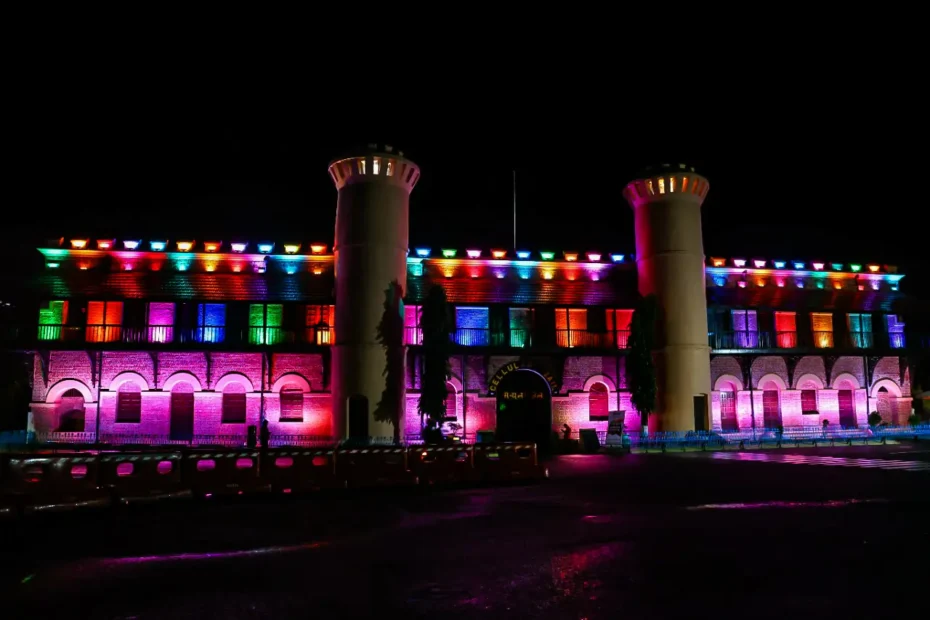
No visit to the national memorial is complete without attending the evening Sound and Light Show, known locally as Light and Sound. Presented within the historic prison courtyard, the dramatic production uses narrative audio, voice acting, and atmospheric lighting to bring the dark history of the penal colony back to life. The narration traces the struggles, heartbreaks, and enduring spirit of the freedom fighters who walked the corridors. Because daily show schedules can occasionally shift based on maintenance or seasonal weather, checking current timings with official ticket counters upon arrival is recommended.
While the Cellular Jail tells the story of penal suffering and resistance, Ross Island—officially designated as Netaji Subhas Chandra Bose Dweep—tells a completely different narrative of British colonial ambition. Managed historically as the administrative headquarters of the Andaman and Nicobar Islands, Ross Island once served as the bustling residential and governing capital of the penal settlement during the late nineteenth and early twentieth centuries. The Port Blair Municipal Council maintains records of the island's colonial past, preserving its unique position as a dual-natured historical site.
Unlike the grim prison cells of the mainland shore, Ross Island was designed for comfort, luxury, and administrative control. It functioned as the "Paris of the East," housing the opulent residence of the Chief Commissioner, government secretariats, high-end bakeries, tennis courts, a swimming pool, a majestic church, and a grand ballroom where British officials hosted elite social events. While political prisoners suffered in isolation at the Cellular Jail across the water, British officers lived a life of isolated privilege amidst manicured gardens and imported luxuries on Ross Island.

Exploring Ross Island today offers a haunting visual contrast between human ambition and the relentless power of nature. Following severe earthquakes and the eventual shifting of administrative headquarters, the island was largely abandoned by the mid-twentieth century. Today, visitors take a short boat ride from Sri Vijaya Puram to walk shaded pathways winding through crumbling colonial brick ruins completely overtaken by massive aerial roots of old banyan trees. You can explore the skeletal remains of the commissioner's bungalow, the old printing press, the bakery ovens, and the silent church. It provides an atmospheric, open-air museum experience that feels worlds away from a standard city tour.
Comparing Cellular Jail with Ross Island reveals a powerful historical duality. Cellular Jail represents the dark underbelly of the penal colony—the suffering, isolation, and political resistance of those who fought against colonial rule. Ross Island represents the polished facade of the same colonial regime—the administrative privilege, social structure, and authority that maintained the penal system. Visiting both locations provides a balanced, comprehensive understanding of how the British established and maintained control over the Andaman Islands.
Combining these two major historical sites into a single itinerary requires thoughtful scheduling. Many travellers prefer dedicating a full day to Sri Vijaya Puram's heritage sites, exploring the ruins of Ross Island by boat during the morning hours, and transitioning to the Cellular Jail in the afternoon to tour the galleries before attending the evening Sound and Light Show. Because ferry departures to Ross Island and museum operating hours depend on local weather and daily schedules, checking current official timings in advance ensures your historical exploration flows smoothly without rushing.
Preparing for a historical sightseeing day requires comfortable walking shoes, sun protection, a reusable bottle of drinking water, and lightweight clothing suitable for humid tropical weather. When visiting sites like the Cellular Jail and Ross Island, maintaining a respectful, quiet demeanor is essential. These locations are national memorials connected to deep national sacrifice and human suffering; they should never be treated as casual backdrops for insensitive photographs or loud social media entertainment. Approaching the history with sincerity and respect ensures that the memory of those who endured Kala Pani is honoured appropriately.
Coordinating multi-island transport, resort accommodation, ferry bookings, and cultural sightseeing requires careful logistical planning. At Andaman Bliss, our local team helps travellers design seamless, customized holiday itineraries that cover every corner of the archipelago. Whether you want to book dedicated Port Blair sightseeing, arrange comprehensive Andaman historical places tours, or secure a fully customised Andaman itinerary, we handle your arrangements reliably. Explore our official website to discover travel solutions designed for your next island getaway.
Discover the ferry booking tricks, SIM card recommendations, and practical island travel tips that every Andaman traveler should know before visiting.
Discover the natural wonders of Baratang Island, from mangrove creeks and limestone caves to the fascinating journey through the Jarawa Reserve.
Trek through tropical forests, race across the sea by speedboat, or explore the ocean floor with sea walking—find the best Elephant Beach experience for your Andaman trip.

