


Andaman Travel Tips 2026: What No One Tells You About Ferries & SIMs
Discover the ferry booking tricks, SIM card recommendations, and practical island travel tips that every Andaman traveler should know before visiting.
Discover the tranquil side of Andaman with a mangrove kayaking adventure through scenic waterways, lush forests, and thriving wildlife habitats.

When the word adventure comes up in conversation, most travellers immediately picture activities that rely on motion, noise, and high adrenaline. You might think of scuba diving deep beneath the surface, jet skis tearing across open bays, parasailing high above the coastline, or speedboats bouncing over coastal waves. These pursuits certainly have their place in an island holiday, offering an energetic way to experience the open sea. However, the Andaman and Nicobar Islands also offer a completely different category of outdoor exploration—one that rewards patience, quiet observation, and a willingness to slow down. Imagine stepping into a light watercraft where there is no motor, no fuel exhaust, and no mechanical roar. As you push off from the shore into a narrow, shaded waterway, the only sound you hear is the gentle dip of your paddle touching the water. Mangrove kayaking in Andaman represents the quiet side of adventure. It is an experience where the journey matters far more than speed, inviting travellers to explore sheltered coastal creeks at a natural pace while paying attention to the living ecosystems that surround them.

At its core, mangrove kayaking is a recreational paddling activity that takes visitors away from open beaches and into the sheltered tidal creeks lined with dense mangrove vegetation. Mangrove forests grow specifically in coastal intertidal zones where land meets sea, thriving in brackish water environments that transition between freshwater runoffs and saline ocean tides. When you navigate these channels in a kayak, you move along narrow water corridors shaded by arching branches and tangled root systems. Because the water in these protected creeks is often calmer than the open sea, it provides an accessible environment for paddling. More importantly, a kayak allows you to enter shallow areas and tight turns that larger motorised tour boats can never reach, offering a direct, low-impact way to observe a coastal habitat that remains hidden from standard tourist roads.
To truly appreciate what you are looking at while paddling through these waterways, it helps to understand why mangrove ecosystems hold such ecological significance for the islands. Official environmental guidelines and environmental reports published by the Ministry of Environment, Forest and Climate Change emphasize that mangroves act as essential natural buffers along tropical coastlines. Their complex, above-ground root networks slow down incoming wave action, helping to protect island shores from severe erosion during storms and tidal surges. Furthermore, the tangled roots serve as vital underwater nurseries for countless species of juvenile fish, crabs, molluscs, and coastal organisms, providing them with protection from open-water predators. When you move quietly through a mangrove creek, you are not simply passing through scenic landscape scenery; you are gliding directly through a vital biological engine that supports the wider marine health of the archipelago.
The distinct feeling of mangrove kayaking becomes obvious the moment you compare it with other coastal water sports. A jet ski is designed entirely around speed and surface thrills. Parasailing focuses on vertical height and an aerial viewpoint. Scuba diving takes you into the deep blue underwater realm. Mangrove kayaking, by contrast, is about lateral movement through a sheltered, intimate landscape. It forces you to match your energy to the environment rather than imposing your speed upon it. Because you are moving without an engine, you do not disturb the ambient soundscape, allowing you to notice small shifts in light, the movement of crabs along the muddy banks, and the subtle currents moving beneath your hull.

Opportunities to experience this tranquil side of the islands are available in selective tourism zones across the territory. Official tourism information published by the Andaman & Nicobar Tourism Department states that visitors can enjoy kayaking through mangrove creeks on Swaraj Dweep, historically and commonly known as Havelock Island, and describes the activity as both adventurous and serene. The island features protected bays and sheltered tidal inlets that lend themselves naturally to non-motorised paddling. Authorized operators conduct guided tours along permitted routes, ensuring that visitors can experience the island's interior waterways safely without straying into restricted zones or sensitive ecological habitats.
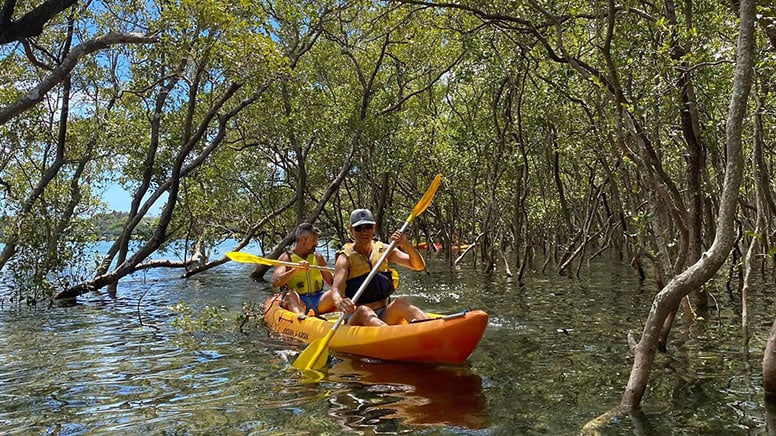
For travellers exploring beyond the main southern tourism circuit, northern settlements also offer natural settings for water-based eco-tourism. Official regional tourism documentation identifies Mayabunder, along with Swaraj Dweep, as an area where kayaking through mangrove creeks is recognised as part of the local adventure offerings. Mayabunder provides a quieter, more remote backdrop for travellers who want to experience northern ecosystems away from the busier resort hubs. Engaging with these northern waterways gives you a broader perspective of how mangrove environments shape the coastline across different districts of the island chain.
A typical kayaking excursion begins on dry land with a practical orientation. Your local guide explains how to hold the double-bladed paddle, how to steer the stable sit-on-top kayak, and how to maintain safe spacing within the group. Once you step into the craft and push away from the launch bank, the first few minutes might feel slightly unfamiliar as you find your balance on the water. However, within a short distance, the rhythm of your strokes becomes automatic. The open water recedes behind you, and the towering mangrove trees close in on either side, forming a natural green corridor. The focus shifts entirely away from reaching a specific physical destination and settles instead on the simple act of moving forward through the quiet landscape.
One of the most striking aspects of spending an hour inside a mangrove creek is the acoustic shift. On the open beaches, your senses are constantly engaged by crashing waves, distant boat engines, resort music, and the chatter of beachgoers. Inside the creeks, those sounds vanish completely, replaced by an acoustic environment defined by nature. You hear the steady, rhythmic drip of water sliding off your paddle blade, the rustle of leaves stirred by a coastal breeze, the sharp call of a kingfisher perched overhead, and the occasional soft splash of a fish breaking the water's surface. This profound quiet provides a mental reset, offering a rare moment of stillness during a busy holiday.
Because mangrove creeks form rich biological habitats, keen-eyed travellers can often spot various forms of coastal wildlife during their paddle. Depending on the location, time of day, and seasonal conditions, sightings can include brightly coloured wading birds, mudskippers resting on exposed roots, small crabs scuttling across the muddy banks, and various marine organisms moving through the shallow water below. However, it is essential to remember that wild animal populations operate entirely on their own schedules. Sightings are never guaranteed, and the primary goal of the excursion is respectful observation rather than wildlife chasing or aggressive photography.
Using a kayak as your primary mode of transport offers unmatched practical advantages for coastal exploration. Kayaks have a shallow draft, allowing them to glide smoothly over water that is too shallow for motorised boats. They produce zero underwater propeller noise, which significantly reduces the disturbance to shy marine and avian species. Furthermore, being seated only inches above the water line places you directly inside the environment, allowing you to examine intricate root structures, falling seed pods, and tidal water movements with complete clarity.
A common question among prospective visitors is whether kayaking requires advanced athletic training or previous paddling experience. Recreational guided mangrove kayaking is designed to be accessible for beginners and casual holidaymakers. You do not need to be an expert athlete to enjoy a suitable, beginner-friendly route. The kayaks used by authorised operators are wide, stable models built for balance rather than speed. While paddling does require continuous upper-body movement and basic physical stamina, the pace is kept relaxed and comfortable, allowing plenty of time to rest and absorb the scenery.
Families travelling through the islands frequently look for outdoor activities that older children and parents can share comfortably together. Suitability for families depends on the child's age, swimming ability, the specific design of the kayak—such as tandem setups where a child shares a boat with an adult—and the safety rules enforced by the operator. Parents should always confirm minimum age requirements and safety prerequisites with their chosen provider before booking, ensuring the outing matches every family member's comfort level around water.
For couples seeking an outdoor activity that steps away from crowded tourist spots, a shared paddle through a quiet creek offers a wonderful alternative to high-intensity adventures. The slower pace allows partners to share the experience naturally, talking quietly, observing the surrounding forest, and enjoying a peaceful moment together on the water. It provides an engaging shared memory that feels personal and unhurried.
Solo visitors looking to connect with nature find that kayaking provides a deeply independent yet safe way to explore the coast. Joining a guided group ensures you have expert navigation and peer support while still letting you paddle at your own pace and enjoy the meditative quiet of the waterways. Solo travellers should always participate as part of the organised group rather than attempting to explore unfamiliar creeks alone.
Planning your time on the water is closely tied to seasonal weather patterns and local tide tables. The dry months spanning from November through May offer the most reliable conditions for outdoor water activities, featuring calm skies, minimal rainfall, and comfortable temperatures. While the monsoon months bring lush green foliage to the mangrove canopy, they also introduce sudden downpours and swift tidal currents that can make paddling challenging. Authorised operators monitor these conditions daily and will adjust or postpone outings whenever safety requires it.
Choosing between a morning or afternoon paddle comes down to personal preference regarding light and temperature. Morning kayaking sessions often offer the calmest air conditions, cooler temperatures, and active bird populations as the forest wakes up. Afternoon sessions, scheduled safely before sunset, provide striking light as the sun filters sideways through the mangrove branches, casting long, peaceful shadows across the water. Both times offer distinct atmospheric rewards depending on your daily holiday schedule.
Preparing your wardrobe for a water-based excursion involves choosing garments that handle moisture comfortably. Opt for lightweight, quick-drying clothing made from athletic fabrics rather than heavy cotton that stays damp. Wear secured water shoes or strapped sports sandals that can get wet without slipping off your feet. Apply sun protection before you launch, and consider wearing a wide-brimmed hat to shield your face and neck from dappled sunlight filtering through the canopy.
Keep your personal belongings minimal when stepping into a kayak. Bring a bottle of drinking water to stay hydrated in the humid forest air, personal medication if required, and a certified waterproof pouch if you want to keep your phone protected while capturing scenery. Avoid carrying unnecessary bags, expensive jewellery, or unsecured valuables that could slip into the water. Always follow your guide's instructions regarding what can be safely brought on board.
Even though mangrove creeks are sheltered from open-sea waves, maintaining safety remains an absolute priority. Authorised excursions are led by trained guides who understand tidal movements, local weather patterns, and the exact boundaries of permitted routes. Participants must wear proper personal flotation devices at all times, stay close to the group, follow the guide's routing instructions, and avoid sudden movements that could unbalance the kayak. Respecting these simple operational rules ensures a secure and relaxing outing for everyone.
It can be tempting to rent a kayak independently and paddle into remote forest creeks without a guide, but doing so introduces significant risks. Mangrove waterways are a complex maze of twisting channels where rising and falling tides can quickly disorient paddlers, leaving them stranded in deep mud or fighting strong, unexpected currents. Furthermore, unfamiliar channels may intersect with restricted zones or unsuitable marine habitats. Sticking exclusively to authorized routes with certified local guides is the only responsible way to experience these delicate ecosystems.
Preserving the delicate ecological balance of the mangrove forests requires a conscious commitment from every visitor. These living coastal systems are sensitive to human disruption. Travellers must never break mangrove roots, leave plastic rubbish or food wrappers behind, make excessive noise, or attempt to feed and disturb local wildlife. Practising responsible tourism ensures that the natural beauty and ecological health of these tidal creeks remain fully protected for all future visitors.
Capturing the quiet beauty of a mangrove creek through photography offers wonderful creative opportunities. The still, mirror-like water surface often creates striking reflections of the arching branches and tangled root systems above. Early morning or late afternoon sunlight filtering through the dense green canopy produces soft, dramatic lighting conditions. When taking pictures, always maintain your balance in the kayak, keeping your movements slow and deliberate to avoid tipping your craft into the water.
Integrating a peaceful paddling session into your broader Andaman holiday is wonderfully straightforward. A morning spent gliding through quiet mangrove creeks pairs naturally with an afternoon relaxing on a white-sand beach or visiting historical sites. Because kayaking is typically a half-day or morning activity, it leaves plenty of time in your itinerary for other explorations, provided you maintain a sensible, unhurried pace across your travel days.
Understanding where mangrove kayaking fits into the spectrum of Andaman adventure helps you design a balanced holiday. If you want high-speed motion, motor sports like jet skiing deliver excitement. If you want elevation, parasailing offers aerial views. If you want marine exploration, scuba diving takes you beneath the waves. But if you want to connect with nature in absolute quiet, using your own muscle power to glide through a shaded coastal forest provides an experience that no engine-powered vessel can ever replicate.
The activity appeals naturally to a broad cross-section of travellers. It suits nature lovers who want a close-up look at island ecology, first-time paddlers looking for an approachable water sport, couples wanting a shared outdoor experience, and families who meet the operator's requirements. It is tailor-made for anyone who values quiet exploration over high-speed thrills and wants to see a different, more contemplative side of the Andaman Islands.
Being realistic about your personal travel preferences ensures you choose activities you will genuinely enjoy. Mangrove kayaking may not appeal to travellers who are looking for high-octane speed, non-stop adrenaline, or intense physical exhaustion. Those who prefer structured indoor sightseeing, lively resort nightlife, or bustling commercial entertainment venues will likely find the quiet stillness of the tidal creeks too slow for their tastes.
Selecting a reliable provider for your paddling excursion requires verifying that the company operates within official regional guidelines. Ensure the operator utilizes certified local guides, provides proper safety equipment and stable kayaks, follows authorised and permitted routes, and maintains a clear weather policy. The official Andaman & Nicobar Tourism Department maintains active directories of registered water-sport providers. Verifying operator credentials guarantees your activity meets official safety and environmental standards.
Coordinating water sports, inter-island ferries, resort accommodation, and regional sightseeing requires careful logistical planning. At Andaman Bliss, we help travellers design seamless, customized holiday itineraries that cover every corner of the archipelago. Whether you want to add eco-paddling sessions to your trip, arrange a complete Havelock Island tour, or secure a fully customised Andaman itinerary, our local team handles your arrangements reliably. Explore our official website to discover travel solutions designed for your next island getaway.
Discover the ferry booking tricks, SIM card recommendations, and practical island travel tips that every Andaman traveler should know before visiting.
Visit Cellular Jail and Ross Island to uncover the remarkable history of Kala Pani, India's freedom movement, and Andaman's colonial heritage.
Discover the natural wonders of Baratang Island, from mangrove creeks and limestone caves to the fascinating journey through the Jarawa Reserve.

